Tag: strength-training

  • What Are Resistance Bands? A Beginner-Friendly Introduction

    What Are Resistance Bands? A Beginner-Friendly Introduction

    If you’re just getting into fitness, resistance bands can seem almost too simple to be effective.

    They’re lightweight, inexpensive, easy to store, and don’t look nearly as intimidating as rows of dumbbells or massive gym machines. Because of that, a lot of beginners assume resistance bands are only meant for stretching or physical therapy.

    In reality, resistance bands are one of the most versatile and beginner-friendly pieces of fitness equipment you can own.

    For bigger beginners especially, they can make working out feel much more approachable.


    So, What Exactly Are Resistance Bands?

    Resistance bands are elastic exercise bands designed to create tension during movement. Instead of lifting a fixed weight like a dumbbell or barbell, your muscles work against the resistance created as the band stretches.

    That tension forces your muscles to engage throughout the exercise.

    The farther the band stretches, the more resistance it creates. That’s one of the reasons resistance bands feel different from traditional weights. The resistance changes dynamically during the movement instead of staying constant the entire time.

    Despite their simple appearance, resistance bands can be used for:

    • strength training
    • mobility work
    • stretching
    • rehabilitation
    • muscle building
    • warmups
    • full-body workouts

    They’re used by complete beginners, physical therapists, athletes, and even experienced lifters looking to add variety to their training.


    Why Resistance Bands Are So Popular for Beginners

    One of the biggest advantages of resistance bands is accessibility.

    A lot of workout equipment can feel overwhelming when you’re starting out. Gym machines often require setup knowledge, free weights can feel intimidating, and large home gym setups are expensive and take up space.

    Resistance bands remove a lot of that friction.

    They’re:

    • affordable
    • portable
    • easy to store
    • low-impact
    • beginner-friendly

    You can use them in a small apartment, bedroom, office, or living room without needing a dedicated workout space.

    For bigger guys or people returning to fitness after a long break, that simplicity can make a huge difference psychologically. Working out starts to feel manageable instead of overwhelming.


    Do Resistance Bands Actually Work?

    Yes — absolutely.

    This is probably the biggest misconception surrounding resistance bands.

    A lot of people assume they aren’t “serious” enough for real workouts because they don’t look as intense as heavy weights. But your muscles respond to resistance and tension, regardless of where that tension comes from.

    Resistance bands can help:

    • build muscle
    • improve strength
    • increase mobility
    • support weight loss
    • improve conditioning

    Especially for beginners, resistance bands are more than effective enough to create noticeable progress.

    In many cases, they’re actually a better starting point than heavy free weights because they place less stress on the joints and allow for more controlled movement patterns.


    The Different Types of Resistance Bands

    Not all resistance bands are the same, and understanding the different styles can help you choose the right option for your goals.

    Tube Resistance Bands

    These are the most common beginner bands and usually include handles. They often come in sets with multiple resistance levels and accessories like door anchors.

    Tube bands are great for:

    • rows
    • chest presses
    • curls
    • shoulder exercises
    • full-body workouts

    For most beginners, this is the easiest place to start.


    Loop Bands

    Loop bands are smaller circular bands commonly used for lower body exercises and mobility work.

    You’ll often see them used for:

    • squats
    • glute activation
    • hip exercises
    • stretching

    They’re simple but surprisingly effective.


    Pull-Up Assist Bands

    These are larger heavy-duty loop bands designed to provide stronger resistance.

    They’re often used for:

    • pull-up assistance
    • advanced strength training
    • mobility work
    • compound exercises

    They can be incredibly versatile once you become more experienced.


    Fabric Resistance Bands

    Fabric bands have become popular because they feel more comfortable and tend to stay in place better during exercises.

    They’re especially useful for lower body movements and are often preferred over rubber bands for glute-focused workouts.


    Why Bigger Beginners Often Prefer Resistance Bands

    For larger beginners, traditional workouts can feel rough physically and mentally.

    High-impact exercises may aggravate the knees or lower back. Some gym environments feel intimidating. And jumping directly into heavy lifting can feel discouraging quickly.

    Resistance bands offer a softer entry point into fitness.

    The movements are often easier on the joints, the workouts can be done privately at home, and the resistance feels more controlled compared to free weights.

    Most importantly, resistance bands make it easier to start building consistency.

    And honestly, consistency matters far more than having the “perfect” workout plan.


    Are Resistance Bands Better Than Dumbbells?

    Not necessarily better — just different.

    Dumbbells are excellent for traditional strength training and progression. Resistance bands offer more portability, lower impact, and easier home workout accessibility.

    For many beginners, especially bigger guys trying to build confidence with fitness, resistance bands simply feel more approachable.

    Eventually, many people use both.

    But there’s absolutely nothing wrong with starting with bands.


    Final Thoughts

    Fitness doesn’t need to start with an expensive gym membership or a complicated workout routine.

    For many people, resistance bands are the first piece of equipment that makes exercise feel realistic and manageable.

    They’re simple, versatile, affordable, and surprisingly effective. More importantly, they help remove many of the barriers that stop people from starting in the first place.

    And when you’re trying to build a healthier lifestyle, getting started is often the hardest part.
  • Why Resistance Bands Should Be Your First Choice as a Beginner

    Why Resistance Bands Should Be Your First Choice as a Beginner

    One of the hardest parts of starting fitness is figuring out where to begin.

    The internet throws thousands of conflicting opinions at you almost immediately. One person says you need a gym membership. Another says you need heavy compound lifts. Someone else insists you need expensive supplements, a strict meal plan, and a six-day workout split before you can make real progress.

    For a lot of bigger beginners, all of that information becomes overwhelming fast.

    That’s one of the reasons resistance bands are such a good starting point.

    They simplify fitness.

    You don’t need a complicated setup. You don’t need years of gym experience. You don’t need to spend thousands building a home gym or force yourself into an environment that makes you uncomfortable.

    You just need a manageable way to start moving consistently.

    For many people, resistance bands are exactly that.


    They Remove a Lot of the Intimidation

    Walking into a gym for the first time can feel uncomfortable, especially if you’re overweight, out of shape, or haven’t exercised in years.

    A lot of people avoid fitness entirely because they don’t want to:

    • feel judged
    • use equipment incorrectly
    • look inexperienced
    • struggle in front of others

    Resistance bands remove a huge portion of that anxiety.

    You can work out at home. You can learn movements privately. You can take your time figuring things out without feeling rushed or self-conscious.

    That comfort matters more than most people realize.

    A beginner workout routine only works if you actually stick with it, and people are much more likely to stay consistent when fitness feels approachable instead of intimidating.


    Resistance Bands Are Easier on the Joints

    This is especially important for bigger guys.

    When you’re carrying extra weight, your knees, hips, lower back, and shoulders are already dealing with additional stress daily. Jumping immediately into high-impact workouts or heavy lifting can feel miserable physically.

    Resistance bands provide smoother, more controlled resistance compared to many traditional exercises. That lower-impact style of training can make workouts feel much more manageable in the beginning.

    That doesn’t mean resistance bands are “easy.” You can still get an excellent workout with them. They simply allow many beginners to train without feeling like every workout is punishing their joints.

    And honestly, workouts shouldn’t feel like punishment.


    They Make Home Workouts Actually Realistic

    A lot of people want to work out at home but assume they need:

    • a bench
    • a squat rack
    • dumbbells
    • expensive cardio machines
    • an entire spare room

    The reality is that resistance bands can provide a full-body workout while taking up almost no space.

    You can train:

    • chest
    • back
    • shoulders
    • arms
    • legs
    • core

    using equipment that fits in a drawer or backpack.

    That simplicity removes another major barrier to consistency.

    If setting up your workout feels complicated, you’re less likely to do it regularly. Resistance bands make exercise feel easier to access, which makes it easier to build habits around it.


    They’re Affordable

    Fitness can get expensive fast.

    Gym memberships, workout equipment, supplements, and fitness apps all add up quickly, especially when you’re still figuring out what actually works for you.

    Resistance bands are one of the lowest-cost ways to start strength training.

    A single quality set can support dozens of exercises and provide enough resistance for months or even years of progression.

    That affordability matters because beginners shouldn’t feel pressured to make huge financial commitments before they even know if they enjoy working out consistently.


    They Help You Focus on Consistency Instead of Ego

    One of the biggest problems with traditional gym culture is how heavily it emphasizes intensity and performance.

    Everything becomes about:

    • lifting heavier
    • pushing harder
    • doing more

    For beginners, especially bigger beginners, that mindset can become discouraging quickly.

    Resistance bands naturally shift the focus toward movement quality, control, and consistency. Because the workouts feel more approachable, people are often more willing to stick with them long enough to build real habits.

    And honestly, consistency is what changes your body.

    Not one extreme workout.
    Not one burst of motivation.
    Not one “perfect” week.

    Long-term consistency matters far more than intensity during the early stages of fitness.


    Resistance Bands Still Let You Get Stronger

    A lot of beginners worry that resistance bands won’t be challenging enough over time.

    That usually comes from the misconception that bands are only meant for stretching or rehabilitation.

    But resistance bands absolutely create meaningful resistance. They can help build muscle, improve conditioning, and increase strength when used consistently.

    As you improve, you can:

    • increase resistance
    • slow down reps
    • increase training volume
    • use thicker bands
    • combine multiple bands

    There’s far more room for progression than most people expect.

    For many beginners, resistance bands can remain effective for a very long time before additional equipment becomes necessary.


    They Make Starting Feel Smaller

    This may actually be the biggest advantage of all.

    A lot of people struggle to start fitness because the entire process feels too big.

    The gym feels overwhelming. The routines feel complicated. The lifestyle changes feel extreme.

    Resistance bands shrink the problem.

    Instead of thinking:

    “I need to completely transform my life.”

    you start thinking:

    “I can probably do a 20-minute workout in my living room.”

    That mental shift matters.

    Big goals become achievable when they’re broken into manageable steps.


    Final Thoughts

    Fitness doesn’t need to begin with extreme workouts, expensive equipment, or perfect confidence.

    For a lot of bigger beginners, resistance bands are the first thing that makes exercise feel realistic instead of overwhelming.

    They’re affordable, beginner-friendly, easier on the joints, and simple enough to remove many of the barriers that stop people from getting started in the first place.

    Most importantly, they make consistency easier.

    And in the long run, consistency will always matter more than intensity.

  • Can You Actually Build Muscle With Resistance Bands?

    Can You Actually Build Muscle With Resistance Bands?

    One of the biggest misconceptions about resistance bands is that they’re only useful for stretching, rehab, or lightweight workouts.

    A lot of people assume that if you want to build real muscle, you eventually need to move on to dumbbells, barbells, or gym machines.

    But the truth is, resistance bands absolutely can help you build muscle.

    In fact, for many beginners — especially bigger guys starting fitness later in life — resistance bands may actually be one of the smartest ways to begin building strength and muscle safely.

    The important thing is understanding how muscle growth actually works.


    Your Muscles Don’t Care Where the Resistance Comes From

    Muscle growth happens when your muscles are challenged consistently over time.

    Your body responds to:

    • tension
    • effort
    • progressive overload

    That tension can come from:

    • dumbbells
    • barbells
    • machines
    • cables
    • resistance bands

    Your muscles don’t know whether you’re lifting metal weights or stretching a band. They only know they’re being forced to work against resistance.

    That’s why resistance bands can absolutely stimulate muscle growth when used properly.


    Resistance Bands Create Constant Tension

    One of the unique things about resistance bands is how they apply resistance throughout a movement.

    With traditional weights, some exercises become easier at certain points because gravity stays consistent. Resistance bands work differently. As the band stretches, tension increases.

    That means your muscles often stay engaged for a larger portion of the movement.

    For beginners, this can actually make exercises feel surprisingly challenging very quickly.

    If you’ve never tried a proper set of resistance band rows, chest presses, or squats before, you may be shocked at how effective they feel.


    Beginners Don’t Need “Perfect” Training to Build Muscle

    This is important to understand.

    A lot of fitness advice online is geared toward advanced lifters trying to maximize every possible percentage of muscle growth. Beginners don’t need that level of optimization.

    When you’re first starting out, your body responds well to almost any consistent resistance training.

    That means:

    • basic movements work
    • moderate resistance works
    • simpler routines work

    You do not need:

    • a complicated bodybuilding split
    • massive amounts of weight
    • two-hour workouts
    • advanced gym equipment

    You need consistency and progressive challenge over time.

    Resistance bands are more than capable of providing that.


    Progressive Overload Still Matters

    If you want to build muscle with resistance bands, you still need progression.

    This is where a lot of beginners go wrong. They use the same band, the same resistance, and the same repetitions forever, then wonder why progress stalls.

    Your body adapts over time. To continue building muscle, you gradually need to increase the challenge.

    With resistance bands, progression can happen in several ways.

    You can:

    • move to a heavier band
    • combine multiple bands
    • increase repetitions
    • slow down the movement
    • increase workout volume
    • reduce rest time
    • improve range of motion

    Muscle growth isn’t just about adding heavier weights every week. It’s about consistently giving your body a reason to adapt.


    The Best Resistance Band Exercises for Building Muscle

    You can train almost every major muscle group effectively using resistance bands.

    Some of the best beginner-friendly muscle-building exercises include:

    • rows
    • chest presses
    • squats
    • shoulder presses
    • curls
    • tricep extensions
    • Romanian deadlifts
    • band pull-aparts

    Compound movements are especially valuable because they train multiple muscle groups at once and allow you to build overall strength more efficiently.

    For bigger beginners, these movements also tend to feel more approachable and less intimidating than traditional barbell training.


    Time Under Tension Matters More Than People Think

    One of the advantages resistance bands offer is increased time under tension.

    In simpler terms, your muscles stay engaged throughout more of the movement.

    That’s useful for muscle growth because controlled tension creates a strong muscular stimulus even without extremely heavy loads.

    This is why resistance band workouts often feel deceptively difficult. The resistance may not look impressive compared to heavy weights, but your muscles are still working continuously.

    For beginners especially, that can be more than enough to create progress.


    You Don’t Need to Train Like an Influencer

    Fitness content online often creates unrealistic expectations.

    You’ll see people lifting massive weights, training six days a week, or following hyper-optimized bodybuilding programs. That can make beginners feel like simpler workouts aren’t “real” training.

    That’s not true.

    Building muscle is not reserved for elite gym culture.

    If you consistently challenge your muscles, recover properly, and eat enough protein, your body will adapt over time. Resistance bands absolutely count as resistance training.

    And honestly, the best workout program is the one you can realistically stick with long term.


    Resistance Bands Are Especially Good for Building Confidence

    This part often gets overlooked.

    For many bigger beginners, the biggest challenge isn’t muscle growth itself. It’s getting comfortable with fitness in the first place.

    Resistance bands create a much lower-pressure environment for learning movement patterns, developing consistency, and building physical confidence.

    That matters.

    Because once people start feeling stronger and more capable, they’re much more likely to continue progressing.

    The hardest part of fitness is rarely the exercises themselves. It’s building enough momentum to keep going.


    Will Resistance Bands Eventually Become Limiting?

    Possibly — depending on your goals.

    If your long-term goal is becoming extremely strong or pursuing advanced bodybuilding-style training, you may eventually want additional equipment like dumbbells or barbells.

    But most beginners are nowhere near that point.

    For building:

    • foundational strength
    • muscle tone
    • conditioning
    • consistency
    • confidence
    • healthier habits

    resistance bands can remain effective for a very long time.

    And even experienced lifters continue using them because they’re versatile, portable, and joint-friendly.


    Final Thoughts

    You absolutely can build muscle with resistance bands.

    More importantly, resistance bands can help you build the habits, confidence, and consistency that actually lead to long-term physical change.

    That’s what matters most in the beginning.

    Fitness doesn’t need to start with extreme workouts or intimidating gym environments. Sometimes the best approach is simply choosing equipment that makes it easier to start moving consistently.

    For many bigger beginners, resistance bands do exactly that.

  • The Different Types of Resistance Bands Explained

    The Different Types of Resistance Bands Explained

    If you’re new to resistance training, one of the first confusing things you’ll notice is that there isn’t just one type of resistance band.

    Search for resistance bands online and suddenly you’re looking at:

    • loop bands
    • tube bands
    • fabric bands
    • pull-up bands
    • therapy bands

    For beginners, especially bigger guys just trying to get started, that can feel overwhelming fast.

    The good news is that you do not need every type of resistance band to start seeing results. In fact, most beginners only need one good set to begin building strength, improving mobility, and creating a consistent workout routine.

    Still, understanding the different types of resistance bands can help you choose the right option for your goals and avoid wasting money on equipment you may not even use.


    Tube Resistance Bands

    When most beginners think about resistance bands, this is usually the style they picture first.

    Tube resistance bands are elastic cords with handles attached to each end. They often come in sets with multiple resistance levels and accessories like door anchors or ankle straps.

    These are arguably the most beginner-friendly type of resistance band because they feel closest to traditional gym equipment.

    You can use them for exercises like:

    • rows
    • chest presses
    • shoulder presses
    • curls
    • tricep extensions

    For many bigger beginners, tube bands are a great starting point because the handles make exercises feel more natural and controlled compared to some other band styles.

    They’re also versatile enough to support full-body workouts without requiring much space.

    If someone asked for the single easiest entry point into resistance band training, tube bands would probably be the answer.


    Loop Resistance Bands

    Loop bands are circular elastic bands that form a continuous loop rather than having handles.

    These are commonly used for:

    • lower body workouts
    • mobility drills
    • glute exercises
    • stretching
    • warmups

    You’ve probably seen them used in fitness videos involving squats, side steps, or hip activation exercises.

    Loop bands are simple, lightweight, and extremely portable. They’re especially useful for improving lower body stability and mobility, which can be important for bigger beginners dealing with tight hips, weak glutes, or limited movement from long periods of inactivity.

    There are usually two main styles:

    • thin rubber loop bands
    • thicker fabric loop bands

    Both work well, though many people find fabric versions more comfortable because they don’t roll up as easily during exercises.


    Pull-Up Assist Bands

    Pull-up assist bands are larger and thicker loop-style bands designed to handle significantly more resistance.

    These are often used to:

    • assist with pull-ups
    • support advanced strength exercises
    • increase resistance during workouts
    • improve mobility and stretching

    They look intimidating at first, but they’re actually one of the most versatile forms of resistance bands available.

    A single heavy-duty pull-up band can be used for:

    • rows
    • presses
    • squats
    • deadlift variations
    • mobility work
    • assisted exercises

    Many experienced home gym users prefer these because they offer more resistance and durability than smaller beginner bands.

    For someone just starting out, though, they can feel slightly less intuitive than tube bands with handles.


    Fabric Resistance Bands

    Fabric resistance bands became extremely popular over the last several years, especially for lower body workouts.

    Unlike traditional rubber bands, these are made from thick elastic fabric material. They tend to feel softer against the skin and are less likely to snap, twist, or roll during exercises.

    Fabric bands are especially popular for:

    • glute training
    • leg workouts
    • hip activation
    • mobility exercises

    Many beginners prefer them simply because they feel more comfortable and stable.

    That said, fabric bands are usually more limited in exercise variety compared to tube bands or pull-up assist bands. They’re excellent additions to a workout setup, but probably not the only type of resistance band most beginners need.


    Therapy Bands

    Therapy bands are thin flat resistance bands commonly used in physical therapy and rehabilitation settings.

    They’re typically lighter in resistance and designed for:

    • rehabilitation exercises
    • mobility work
    • joint recovery
    • gentle movement training

    For some bigger beginners dealing with injuries, severe mobility limitations, or chronic joint discomfort, therapy bands can actually be a very approachable place to start.

    However, most people looking for full-body strength training will eventually want something with more resistance and versatility.


    Which Type of Resistance Band Is Best for Beginners?

    For most beginners — especially bigger guys starting fitness from home — tube resistance bands with handles are usually the easiest and most versatile choice.

    They:

    • feel intuitive
    • work for full-body workouts
    • mimic gym exercises well
    • allow easy resistance adjustments
    • support beginner-friendly movement patterns

    From there, many people eventually add:

    • loop bands for lower body work
    • fabric bands for comfort
    • pull-up assist bands for heavier resistance

    But you do not need to build a giant collection immediately.

    One of the biggest mistakes beginners make is overcomplicating fitness before they even start.


    You Don’t Need Every Piece of Equipment

    Fitness culture often pushes the idea that progress requires endless gear upgrades.

    In reality, consistency matters far more than having the “perfect” setup.

    A simple resistance band routine done consistently three times a week will produce far more results than an expensive home gym that rarely gets used.

    That’s one of the reasons resistance bands are such a good starting point. They remove a lot of the barriers that make fitness feel overwhelming.

    You don’t need a complicated system.
    You don’t need thousands of dollars in equipment.
    You just need something approachable enough to help you start moving regularly.


    Final Thoughts

    Resistance bands come in several different styles, but they all serve the same basic purpose: helping you create resistance during exercise in a simple, accessible way.

    For beginners, especially bigger guys trying to build confidence with fitness, they can be one of the easiest ways to start strength training at home without feeling overwhelmed.

    And honestly, that accessibility is what makes them so valuable in the first place.

  • Resistance Bands: How to Choose the Right Resistance Level

    Resistance Bands: How to Choose the Right Resistance Level

    One of the first things beginners notice when shopping for resistance bands is how many different resistance levels exist.

    Light. Medium. Heavy. Extra heavy. Beginner sets with color-coded bands that somehow all look the same until you actually try using them.

    It can get confusing quickly.

    A lot of people assume they should buy the heaviest bands possible so they can “grow into them” later. Others worry about starting too light and feeling like they wasted money.

    The truth is, most beginners — especially bigger beginners — are better off starting with less resistance than they think they need.

    That may sound counterintuitive, but when you’re first getting into fitness, your goal is not to impress yourself with resistance levels. Your goal is to build consistency, learn movement patterns, and avoid turning workouts into something miserable.

    Choosing the right resistance level is about making exercise sustainable.


    Why Resistance Level Matters

    Resistance bands work by creating tension as they stretch. The heavier the band, the more force your muscles need to generate to move it.

    If the resistance is too light, exercises may not feel challenging enough over time. But if the resistance is too heavy, something else usually happens:

    • form breaks down
    • movements feel awkward
    • joints compensate
    • workouts become frustrating

    That’s especially important for beginners because learning proper movement mechanics matters more than maximizing intensity early on.

    A lot of people underestimate how difficult resistance bands can feel once tension increases. Even experienced gym-goers are sometimes surprised by how challenging certain band exercises become when performed correctly.

    You do not need extreme resistance to get an effective workout.


    Bigger Beginners Often Make One Common Mistake

    A lot of bigger guys assume they automatically need heavier resistance because they’re physically larger.

    That’s understandable, but body size and exercise readiness are not always the same thing.

    If you’re returning to fitness after years of inactivity, your:

    • joints
    • stabilizer muscles
    • mobility
    • endurance
    • movement control

    may still need time to adapt regardless of overall body size.

    Starting with manageable resistance allows your body to learn movement patterns safely without overwhelming your joints or energy levels immediately.

    Remember, fitness is not a test of toughness during your first week. It’s a long-term process of gradual improvement.


    What “Good Resistance” Actually Feels Like

    A good resistance level should feel challenging without making the movement impossible.

    You should still be able to:

    • control the exercise
    • maintain decent form
    • complete your repetitions
    • feel muscle engagement instead of joint strain

    A simple way to think about it:
    if you cannot perform the movement smoothly, the resistance is probably too heavy.

    On the other hand, if the exercise feels effortless and you could continue indefinitely without fatigue, it may eventually be too light.

    Most beginners benefit from resistance levels that allow them to complete around 10–15 controlled repetitions while still feeling challenged near the end of the set.


    Understanding Resistance Band Colors

    One confusing thing about resistance bands is that colors are not standardized across brands.

    A red band from one company may feel completely different from a red band from another company.

    Still, most beginner sets generally follow a similar progression:

    • lighter colors = lighter resistance
    • darker colors = heavier resistance

    Many sets include:

    • light
    • medium
    • heavy
    • extra heavy

    For most beginners, a combination of light and medium resistance bands is more than enough to start.

    Different exercises also require different resistance levels. For example, your legs are typically much stronger than your shoulders or arms, so you may naturally use heavier resistance for squats than for shoulder exercises.

    That’s completely normal.


    You Don’t Need Maximum Resistance Immediately

    Fitness culture often pushes the idea that harder is always better.

    But beginners frequently make faster progress when workouts feel approachable instead of exhausting.

    If every session leaves you:

    • overly sore
    • frustrated
    • exhausted
    • discouraged

    you’re much less likely to stay consistent.

    The best beginner workout is not the hardest one possible. It’s the one you can realistically repeat week after week.

    Resistance bands should help you build momentum, not destroy it.


    How Progression Works With Resistance Bands

    Eventually, you will outgrow certain resistance levels. That’s a good thing.

    Progression simply means your body is adapting.

    As exercises become easier, you can increase the challenge by:

    • using a heavier band
    • combining multiple bands
    • slowing down repetitions
    • increasing workout volume
    • reducing rest time
    • improving range of motion

    Muscle growth and strength development happen through gradual progression over time, not sudden jumps in intensity.

    That’s why starting lighter is completely fine. You’re giving yourself room to improve.


    Adjustable Resistance Sets Are Usually the Best Option

    For most beginners, a resistance band set with multiple resistance levels is the smartest purchase.

    It gives you flexibility to:

    • experiment with different exercises
    • adjust intensity
    • progress gradually
    • train multiple muscle groups effectively

    Certain exercises naturally require more resistance than others. Having options makes your workouts feel much smoother and more adaptable.

    A single ultra-heavy band often limits beginners more than it helps them.


    Don’t Let Ego Dictate Your Starting Point

    This is probably the most important thing to remember.

    A lot of people approach fitness with the mindset that struggling more automatically means progressing more. But beginner fitness is not about proving how tough you are.

    It’s about building a foundation.

    If lighter resistance allows you to:

    • move correctly
    • stay consistent
    • recover properly
    • build confidence

    then lighter resistance is the right choice.

    There is absolutely nothing wrong with starting small.


    Final Thoughts

    Choosing the right resistance level is less about finding the “perfect” band and more about finding a starting point that feels manageable and sustainable.

    For most beginners, especially bigger guys getting back into fitness, lighter and medium resistance bands are more than enough to build strength, improve conditioning, and create consistency.

    The goal is not to jump immediately into the hardest workouts possible.

    The goal is to keep showing up long enough for progress to happen.

  • 5 Best Resistance Band Exercises for Beginners

    5 Best Resistance Band Exercises for Beginners

    One of the biggest mistakes beginners make when starting fitness is trying to learn too many exercises at once.

    You do not need fifty complicated movements or a massive workout program to begin getting stronger. In fact, most people are better off mastering a handful of simple foundational exercises first.

    That’s especially true if you’re starting fitness at a larger size, returning after years away from exercise, or simply trying to build confidence with movement again.

    Resistance bands are great for this because they allow you to train your entire body with simple, approachable exercises that feel less intimidating than traditional gym equipment.

    These five movements are beginner-friendly, effective, and easy to perform at home with minimal setup.


    1. Resistance Band Row

    If you spend most of your day sitting at a desk, driving, or looking at screens, rows are one of the best exercises you can start doing immediately.

    Rows help strengthen the upper back and improve posture, which becomes increasingly important when beginning a fitness journey.

    How to Do It

    Start by anchoring your resistance band around something sturdy at chest height. A closed door with a door anchor works well for most beginners.

    Grab the handles or ends of the band and step backward until there’s light tension in the band while your arms are extended.

    Stand with your feet shoulder-width apart and keep a slight bend in your knees. Keep your chest up and shoulders relaxed.

    From there, pull the handles toward your torso while squeezing your shoulder blades together. Think about driving your elbows backward rather than pulling with your hands.

    Once the handles reach your sides, pause briefly before slowly extending your arms back to the starting position.

    Common Mistakes

    A lot of beginners shrug their shoulders upward during rows or lean backward too aggressively. Try to keep your shoulders relaxed and your torso stable throughout the movement.

    What You Should Feel

    You should mainly feel this exercise in your:

    • upper back
    • rear shoulders
    • lats
    • arms secondarily

    If you mostly feel it in your neck, your shoulders are probably tensing too much.


    2. Resistance Band Chest Press

    The chest press is one of the easiest ways to train pushing muscles at home without needing a bench press setup.

    For many bigger beginners, this movement feels much safer and more approachable than traditional barbell pressing.

    How to Do It

    Anchor the band behind you at chest level.

    Grab the handles and face away from the anchor point. Step forward slightly until there’s tension in the band.

    Start with your hands positioned near your chest and elbows bent.

    Press the handles forward until your arms extend in front of you. Focus on pushing smoothly rather than snapping the movement quickly.

    Once your arms are extended, slowly return to the starting position with control.

    Common Mistakes

    Many beginners allow the bands to pull their arms back too quickly. Try to control both directions of the movement rather than only focusing on the pressing part.

    Also avoid locking your elbows aggressively at the top.

    What You Should Feel

    You should primarily feel:

    • chest
    • shoulders
    • triceps

    The movement should feel controlled and stable, not jerky.


    3. Resistance Band Squat

    Squats are one of the best full-body beginner exercises because they help strengthen the legs while improving balance and mobility.

    For bigger beginners, resistance bands can make squats feel more controlled and less intimidating than heavy weighted versions.

    How to Do It

    Stand on the center of the resistance band with your feet about shoulder-width apart.

    Hold the handles near your shoulders or at chest level depending on your band setup.

    Begin the movement by pushing your hips backward slightly while bending your knees. Lower yourself slowly into a squat while keeping your chest upright.

    Go as low as feels comfortable while maintaining control.

    Once you reach the bottom position, push through your feet and stand back up slowly.

    Common Mistakes

    A lot of beginners try to squat too deep immediately. That’s unnecessary. Focus more on control and comfort than depth.

    Avoid collapsing your chest forward or allowing your knees to cave inward during the movement.

    What You Should Feel

    You should mainly feel:

    • thighs
    • glutes
    • core engagement

    Some discomfort from effort is normal. Sharp knee pain is not.


    4. Resistance Band Shoulder Press

    Shoulder presses are excellent for building upper body strength and improving stability.

    Using resistance bands often feels gentler on the shoulders compared to heavy dumbbells, which makes this a great beginner option.

    How to Do It

    Stand on the middle of the resistance band with your feet shoulder-width apart.

    Bring the handles up near shoulder level with your palms facing forward.

    Press the handles upward until your arms extend overhead. Move slowly and avoid using momentum.

    Once your arms are extended, lower the handles back down carefully to shoulder level.

    Common Mistakes

    Many beginners arch their lower back too much during overhead presses. Keep your core engaged and avoid leaning backward aggressively.

    Also avoid rushing through the movement.

    What You Should Feel

    You should mainly feel:

    • shoulders
    • upper arms
    • upper chest slightly

    Your neck should stay relaxed throughout the exercise.


    5. Band Pull-Aparts

    Band pull-aparts are one of the simplest but most effective exercises for improving posture and upper back strength.

    They’re especially valuable for people who spend long hours sitting or working at computers.

    How to Do It

    Hold the resistance band in front of you with both hands at shoulder height.

    Your arms should remain mostly straight with a slight bend in the elbows.

    Pull the band apart by moving your arms outward until the band reaches your chest area. Focus on squeezing your shoulder blades together during the movement.

    Slowly return to the starting position with control.

    Common Mistakes

    A lot of people pull the band too low or shrug their shoulders upward. Keep the movement controlled and shoulder-height throughout.

    Avoid snapping the band back quickly.

    What You Should Feel

    You should mainly feel:

    • upper back
    • rear shoulders
    • posture muscles

    This exercise is often surprisingly challenging even with lighter bands.


    Final Thoughts

    You do not need an advanced workout plan to begin getting stronger.

    A handful of foundational resistance band exercises performed consistently can help improve:

    • strength
    • mobility
    • posture
    • confidence
    • overall conditioning

    More importantly, these movements help make fitness feel approachable instead of overwhelming.

    That matters far more than chasing the “perfect” routine during the beginning stages of your fitness journey.

    The goal right now is not perfection.

    It’s building consistency.

  • Beginner Resistance Band Workout: A Simple Routine to Start Right Away

    Beginner Resistance Band Workout: A Simple Routine to Start Right Away

    One of the biggest mistakes beginners make when starting fitness is overcomplicating everything immediately.

    They spend hours researching the “perfect” workout split, watching advanced exercise tutorials, or trying to build a routine that looks like something a professional athlete would follow.

    Then they burn out two weeks later.

    If you’re brand new to resistance bands, your first goal is not optimization. Your first goal is simply getting comfortable moving consistently.

    That’s it.

    You do not need:

    • an intense six-day workout routine
    • complicated exercises
    • advanced fitness knowledge
    • perfect form on every movement

    You just need a manageable starting point that feels realistic enough to repeat consistently.

    This beginner resistance band workout is designed exactly for that.


    Before You Start

    If this is your first time using resistance bands, keep a few things in mind before jumping into the workout.

    First, do not worry about making every exercise perfect immediately. Learning movement patterns takes time. The goal early on is simply building familiarity and confidence.

    Second, start lighter than you think you need to. A lot of beginners choose resistance that’s too heavy because they assume harder automatically means better. In reality, controlled movement and consistency matter much more than intensity at the beginning.

    And finally, remember that soreness is normal, but complete exhaustion is not the goal. You should finish this workout feeling challenged, not destroyed.

    Fitness should feel sustainable.


    How Often Should Beginners Train?

    For most beginners, especially bigger guys returning to fitness after a long break, two or three full-body workouts per week is more than enough.

    That gives your body time to:

    • recover
    • adapt
    • reduce soreness
    • build consistency gradually

    Trying to train every single day immediately usually backfires.

    Rest days are part of progress too.


    The Workout

    This is a simple full-body routine designed to help you build foundational strength and confidence using only a resistance band.

    Move slowly, focus on control, and don’t rush through the exercises.


    1. Resistance Band Rows

    3 Sets of 10–12 Reps

    Rows are one of the best exercises for improving posture and strengthening the upper back.

    Anchor the resistance band around a sturdy object at chest height. Grab the handles and step backward until there’s light tension in the band.

    Pull the handles toward your torso while squeezing your shoulder blades together. Slowly return to the starting position.

    Focus on smooth movement instead of pulling aggressively.

    If you spend most of your day sitting, this exercise will likely feel especially important.


    2. Resistance Band Chest Press

    3 Sets of 10–12 Reps

    This movement trains the chest, shoulders, and triceps while feeling more approachable than traditional bench pressing for many beginners.

    Anchor the band behind you at chest level. Hold the handles near your chest and press them forward until your arms extend in front of you.

    Slowly return to the starting position with control.

    Do not let the band snap your arms backward quickly. Control both directions of the movement.


    3. Resistance Band Squats

    3 Sets of 10–15 Reps

    Squats help strengthen the legs, glutes, and core while improving overall movement and stability.

    Stand on the center of the resistance band with your feet shoulder-width apart. Hold the handles near your shoulders.

    Push your hips backward slightly and lower yourself into a squat as far as feels comfortable. Then stand back up slowly.

    Do not worry about squatting extremely deep immediately. Controlled movement matters much more than depth right now.


    4. Resistance Band Shoulder Press

    2–3 Sets of 10 Reps

    This exercise helps build shoulder strength and upper body stability.

    Stand on the resistance band and bring the handles to shoulder level.

    Press upward until your arms extend overhead, then slowly lower them back down.

    Avoid arching your lower back too much during the movement. Keep your core engaged and move slowly.


    5. Resistance Band Curls

    2–3 Sets of 12 Reps

    This is a simple beginner-friendly arm exercise that also helps build familiarity with resistance training.

    Stand on the resistance band and hold the handles with your palms facing upward.

    Curl the handles toward your shoulders while keeping your elbows close to your body.

    Slowly lower the handles back down.

    Focus on control instead of swinging the movement with momentum.


    6. Band Pull-Aparts

    2 Sets of 15–20 Reps

    Band pull-aparts are excellent for posture and upper back strength.

    Hold the band in front of you at shoulder height with both hands. Pull the band apart while squeezing your shoulder blades together.

    Slowly return to the starting position.

    This movement is especially useful if you spend long hours sitting at a desk or looking at screens.


    Rest Between Sets

    You do not need to rush through the workout.

    Rest around:

    • 60–90 seconds between sets
    • longer if you feel overly winded

    Remember, this is not a conditioning competition. The goal is controlled strength training and building consistency.


    What If the Workout Feels Too Easy?

    That’s completely fine in the beginning.

    A lot of beginners assume every workout needs to leave them exhausted to be effective. But when you’re just starting out, learning the movements and establishing consistency matters much more than destroying yourself physically.

    As exercises become easier over time, you can:

    • increase resistance
    • add repetitions
    • add another set
    • slow down the movement
    • reduce rest time

    Progress happens gradually.


    What If the Workout Feels Too Hard?

    That’s normal too.

    If certain exercises feel overwhelming:

    • use lighter resistance
    • reduce repetitions
    • shorten the workout
    • focus on movement quality first

    There is nothing wrong with modifying exercises as a beginner.

    Fitness is not about proving toughness. It’s about building a healthier routine you can realistically maintain.


    The Most Important Thing: Consistency

    The biggest mistake beginners make is treating fitness like an all-or-nothing challenge.

    They try to become perfect overnight, miss a few workouts, then feel like they failed completely.

    That mindset destroys consistency.

    A manageable workout done regularly will always outperform a “perfect” plan you cannot stick with.

    That’s why resistance bands are such a powerful starting point. They make fitness feel accessible enough to actually continue doing.


    Final Thoughts

    You do not need a complicated routine to begin making progress.

    You do not need expensive equipment or advanced fitness knowledge either.

    A simple resistance band workout performed consistently can help you:

    • build strength
    • improve conditioning
    • increase mobility
    • develop confidence
    • create healthier habits

    And honestly, those early habits matter far more than having the perfect workout plan.

    The hardest part of fitness is usually getting started.

    If resistance bands make starting feel more approachable, then they’re already doing exactly what they’re supposed to do.

  • Resistance Bands vs Dumbbells: Which Is Better for Beginners?

    Resistance Bands vs Dumbbells: Which Is Better for Beginners?

    If you’re trying to start working out at home, one of the first questions you’ll probably run into is whether you should buy resistance bands or dumbbells.

    Most people automatically assume dumbbells are the “real” option because that’s what traditional fitness culture pushes. Resistance bands are often treated like beginner equipment people eventually graduate from once they get serious.

    But honestly, for a lot of beginners — especially bigger guys starting fitness later in life — resistance bands may actually be the better choice.

    Not because dumbbells are bad. Dumbbells are excellent tools.

    But because resistance bands solve many of the exact problems beginners struggle with most:

    • intimidation
    • joint discomfort
    • cost
    • space limitations
    • inconsistency
    • workout anxiety

    And when you’re just starting out, accessibility matters more than optimization.


    Dumbbells Look Simpler Than They Actually Are

    A lot of people assume dumbbells are automatically beginner-friendly because they’re straightforward.

    Pick weight up.
    Put weight down.

    Simple enough.

    But in reality, dumbbells introduce a lot of challenges very quickly for beginners.

    Heavy dumbbells can feel intimidating. Certain movements place significant stress on the joints if form breaks down. Building a useful dumbbell setup at home also gets expensive surprisingly fast.

    And once you outgrow a certain weight, you often need to buy heavier pairs.

    That’s one of the hidden frustrations with dumbbells:
    they scale awkwardly.

    Resistance bands handle progression much more smoothly.


    Resistance Bands Are Easier on the Joints

    This is one of the biggest reasons resistance bands are such a strong starting point for bigger beginners.

    When you’re carrying extra weight, your knees, shoulders, hips, and lower back are already under additional stress throughout the day. Jumping immediately into heavy free-weight training can feel rough physically, especially if you haven’t exercised consistently in years.

    Resistance bands provide smoother tension with less impact on the joints.

    Movements often feel more controlled and forgiving because the resistance increases gradually as the band stretches. That makes many exercises feel less jarring compared to lifting heavy fixed weights.

    For beginners dealing with:

    • knee discomfort
    • shoulder tightness
    • lower back stiffness
    • limited mobility

    that lower-impact training style can make a huge difference.

    And honestly, workouts that feel manageable are much easier to stick with long term.


    Resistance Bands Remove a Lot of Intimidation

    This part gets overlooked constantly in fitness conversations.

    A lot of beginners are not avoiding exercise because they’re lazy. They’re avoiding exercise because fitness feels overwhelming.

    Resistance bands shrink that barrier significantly.

    A simple set of bands feels approachable. You can work out privately at home. You can learn movements gradually without feeling like you’re doing everything wrong in front of other people.

    That psychological comfort matters more than most fitness influencers acknowledge.

    A workout plan only works if you consistently do it.

    And beginners are far more likely to stay consistent when workouts feel approachable instead of intimidating.


    Resistance Bands Are More Versatile Than People Think

    One of the biggest misconceptions about resistance bands is that they’re limited compared to dumbbells.

    In reality, resistance bands can train nearly every major muscle group effectively.

    You can use them for:

    • chest exercises
    • rows
    • squats
    • shoulder presses
    • curls
    • tricep work
    • mobility
    • stretching
    • recovery
    • warmups
    • conditioning circuits

    They also allow for constant tension throughout movements, which can create surprisingly challenging workouts even with lighter resistance.

    For most beginners, resistance bands provide far more exercise variety than they’ll realistically need for a long time.


    They’re Much More Affordable

    Building a useful dumbbell collection gets expensive quickly.

    You may need:

    • light weights
    • medium weights
    • heavier weights
    • storage racks
    • adjustable systems

    A decent adjustable dumbbell setup alone can cost hundreds of dollars.

    Meanwhile, a quality resistance band set can provide a full-body workout for a fraction of the cost.

    For beginners who are still figuring out whether fitness will become a long-term habit, that lower financial barrier is important.

    You should not need to spend thousands of dollars just to start improving your health.


    Resistance Bands Take Up Almost No Space

    This becomes a huge advantage for people living in:

    • apartments
    • smaller homes
    • shared spaces

    Dumbbells are heavy, bulky, and awkward to store. Resistance bands can fit inside a drawer or backpack while still allowing you to train your entire body.

    That convenience matters because the easier your workouts are to access, the more likely you are to stay consistent.

    If setting up exercise feels complicated, motivation drops quickly.


    Resistance Bands Encourage Better Beginner Habits

    This may actually be their biggest advantage.

    Dumbbells often encourage beginners to chase heavier weight too quickly. Resistance bands naturally shift the focus toward:

    • control
    • movement quality
    • tension
    • consistency

    That’s exactly what most beginners should prioritize anyway.

    When people first start exercising, the goal is not maximizing performance immediately. The goal is building sustainable habits and learning how to move consistently without burning out.

    Resistance bands support that process incredibly well.


    But Can You Still Build Muscle?

    Absolutely.

    This is where a lot of people underestimate resistance bands.

    Your muscles respond to resistance and tension, not the appearance of the equipment. Resistance bands can absolutely help build:

    • muscle
    • strength
    • endurance
    • conditioning

    Especially for beginners.

    In many cases, beginners see excellent results with resistance bands because the workouts feel approachable enough to remain consistent with.

    And consistency is ultimately what creates physical change.


    Are Dumbbells Bad?

    Not at all.

    Dumbbells are fantastic tools and many people eventually incorporate both dumbbells and resistance bands into their workouts.

    But for someone just getting started — especially someone larger, out of shape, intimidated by fitness culture, or returning after years away from exercise — resistance bands often solve more beginner problems than dumbbells do.

    That’s why they’re such a powerful starting point.


    Final Thoughts

    The best workout equipment is not the one that looks the most impressive.

    It’s the one you’ll actually use consistently.

    For many beginners, resistance bands win because they’re:

    • approachable
    • affordable
    • low-impact
    • versatile
    • easy to store
    • beginner-friendly

    Most importantly, they make fitness feel manageable instead of overwhelming.

    And honestly, that’s what most people need in the beginning far more than a heavy set of dumbbells.

  • The Beginner’s Guide to Resistance Bands for Bigger Guys

    The Beginner’s Guide to Resistance Bands for Bigger Guys

    Starting Fitness Doesn’t Have to Feel Impossible

    For a lot of bigger guys, getting into fitness feels intimidating long before the first workout even begins.

    Maybe you’ve thought about joining a gym but never quite felt comfortable walking through the doors. Maybe you’ve watched fitness content online and felt like everyone already knew what they were doing except you. Or maybe you’ve tried working out before and quickly ran into sore joints, exhaustion, embarrassment, or burnout.

    That’s more common than people realize.

    One of the biggest problems with modern fitness culture is that so much of it assumes you’re already in shape. Most workout programs are built around people who already know how to train, already feel comfortable in a gym, and already have a baseline level of mobility and confidence.

    Resistance bands are different.

    They’re approachable. They’re affordable. They’re low-impact. And for a lot of bigger beginners, they remove many of the barriers that make fitness feel overwhelming in the first place.

    You don’t need a gym membership. You don’t need a garage full of equipment. You don’t need to know what every machine does or feel pressured to keep up with people online. You just need a place to start.

    For many people, resistance bands are exactly that.


    What Are Resistance Bands?

    At their core, resistance bands are simply elastic bands that create tension during movement. Instead of lifting a metal weight against gravity, your muscles work against the tension created by the band stretching.

    That sounds simple, but resistance bands are surprisingly versatile. They can be used for strength training, mobility work, stretching, muscle building, rehabilitation, and even cardio-focused workouts. Physical therapists use them. Athletes use them. Beginners use them. Plenty of experienced lifters use them too.

    One of the biggest misconceptions about resistance bands is that they’re somehow “less serious” than traditional weights. People tend to think of them as rehab tools or something only used in warmups, but that really undersells how effective they can be.

    In reality, resistance is resistance. Your muscles don’t know whether tension is coming from a dumbbell, a cable machine, or a resistance band. What matters is that your body is working against resistance consistently over time.

    That’s especially important for beginners because consistency matters far more than perfection.


    Related: What Are Resistance Bands? A Beginner-Friendly Introduction


    Why Resistance Bands Work So Well for Bigger Beginners

    A lot of workout advice online is created by people who have been active their entire lives. They often forget what it feels like to start from scratch while carrying extra weight.

    That changes the experience significantly.

    When you’re bigger, certain exercises feel different. High-impact movements can feel rough on the knees. Some gym machines feel uncomfortable. Even walking into a crowded weight room can feel mentally exhausting before the workout even starts.

    Resistance bands solve a lot of those problems.

    For starters, they’re much easier on the joints than many traditional forms of training. The tension is smoother and more controlled, which can make movements feel more manageable for people dealing with knee discomfort, tight hips, lower back issues, or general stiffness from inactivity.

    They also make home workouts much more realistic. That may not sound like a huge deal on paper, but psychologically, it matters a lot. Being able to exercise privately removes a major source of anxiety for many beginners. You can focus on learning movements and building consistency without feeling like people are watching you or judging your experience level.

    There’s also something important about the simplicity of resistance bands. They lower the barrier to entry. You don’t need to learn dozens of machines or spend thousands building a home gym. A simple set of bands can allow you to train your entire body in a small apartment, bedroom, or living room.

    For someone trying to build momentum, that accessibility matters more than most people think.


    Related: Why Resistance Bands Should Be Your First Choice as a Beginner


    Can You Actually Build Muscle With Resistance Bands?

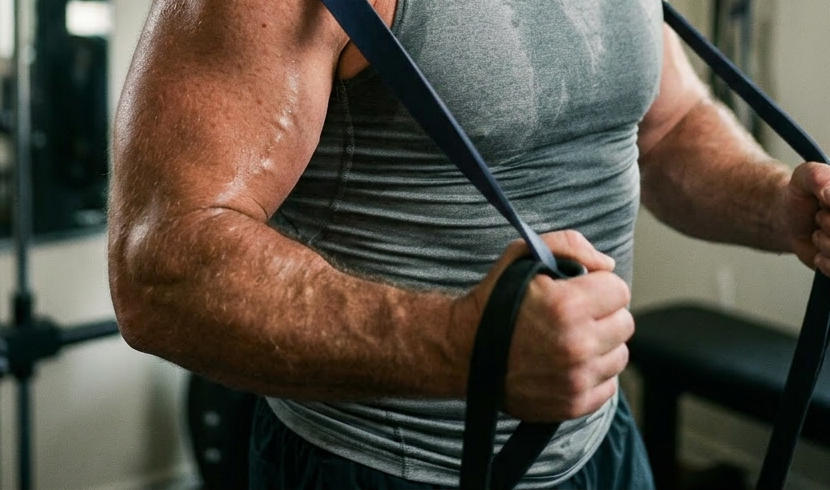
    Muscular man in black tank top flexing biceps in gym

    This is usually the first question people ask after they start taking resistance bands seriously.

    The answer is yes.

    Resistance bands absolutely can help build muscle, especially for beginners. In fact, many people underestimate how challenging band exercises can become once tension increases and movements are performed correctly.

    Your muscles respond to tension and effort. Resistance bands provide both.

    One of the unique things about bands is that tension increases as the band stretches. That means exercises often become more difficult at the top of the movement, creating constant resistance throughout the rep. In some ways, that can actually create a different kind of challenge compared to free weights.

    Now, are resistance bands going to turn someone into a professional bodybuilder overnight? Of course not. But for beginners trying to lose weight, build strength, improve conditioning, or simply become more active, they are more than effective enough.

    And honestly, effectiveness isn’t even the biggest advantage here.

    The real advantage is sustainability.

    A workout program only works if you can stick with it consistently. Resistance bands tend to feel less intimidating, more approachable, and easier to integrate into daily life. That makes consistency much more achievable for many beginners.


    Related: Can You Actually Build Muscle With Resistance Bands?


    The Different Types of Resistance Bands

    Not all resistance bands are the same, and understanding the differences can help you avoid buying equipment that doesn’t fit your goals.

    The most common beginner-friendly option is the tube-style resistance band with handles. These usually come in sets with interchangeable resistance levels and accessories like door anchors. They feel closest to traditional gym equipment and work well for exercises like rows, chest presses, curls, and shoulder movements.

    Loop bands are another common option. These are circular bands often used for lower body exercises and mobility work. You’ve probably seen them used for glute activation exercises online. They’re simple, lightweight, and especially useful for beginners looking to improve stability and mobility.

    There are also larger pull-up assist bands, which are thicker and capable of producing significantly more resistance. These are extremely versatile and can eventually be used for more advanced strength training movements.

    Fabric resistance bands have also become popular in recent years because they tend to feel more comfortable against the skin and don’t roll up as much during exercises.

    For most beginners, though, a simple tube-style set with handles is probably the easiest place to start.


    Related: The Different Types of Resistance Bands Explained


    Choosing the Right Resistance Level

    FlexFit resistance band set with teal light, blue medium, and black heavy bands

    One of the biggest mistakes beginners make is assuming they should immediately use the heaviest resistance possible.

    That mindset usually comes from traditional gym culture where heavier weight is often associated with progress. But when you’re first starting out, learning movement quality and building consistency matter much more than maximizing resistance.

    If the bands are too heavy, exercises become frustrating quickly. Form breaks down, movements feel awkward, and workouts become exhausting instead of encouraging.

    There’s nothing wrong with starting lighter.

    In fact, most people are better off beginning with manageable resistance and focusing on controlled reps, proper positioning, and consistency. Over time, progression happens naturally.

    Fitness isn’t about proving something during your first week. It’s about building habits you can realistically sustain.


    Related: Resistance Bands: How to Choose the Right Resistance Level


    The Best Resistance Band Exercises for Beginners

    One of the nice things about resistance bands is that you don’t need a huge list of exercises to get started.

    A few foundational movements are enough to build a solid beginner routine.

    Band rows are excellent for improving posture and strengthening the upper back, especially if you spend most of your day sitting at a desk. Chest presses provide a beginner-friendly pushing movement that feels less intimidating than traditional bench pressing. Squats with resistance bands can help build lower body strength while still feeling approachable for larger beginners.

    Shoulder presses, curls, and band pull-aparts are also great additions because they target muscles that help improve posture, stability, and overall upper body strength.

    The goal early on is not to train like a professional athlete. The goal is simply to move consistently and build confidence in your ability to exercise regularly.

    That matters far more than having the “perfect” routine.


    Related: 5 Best Resistance Band Exercises for Beginners


    A Simple Beginner Workout

    A lot of people make the mistake of trying to completely overhaul their lives overnight. They jump into six-day workout plans, impossible diet restrictions, and exhausting routines that feel miserable within two weeks.

    You don’t need that.

    A simple full-body resistance band workout done two or three times a week is more than enough for most beginners.

    A basic routine might include rows, chest presses, squats, shoulder presses, curls, and pull-aparts. Nothing fancy. Nothing extreme. Just foundational movements done consistently over time.

    That’s the part fitness culture often skips over. Progress usually comes from boring consistency, not motivational extremes.


    Related: Beginner Resistance Band Workout: A Simple Routine to Start Right Away


    Resistance Bands vs Dumbbells

    People often frame this as an either-or debate, but it really isn’t.

    Dumbbells are great. Resistance bands are great too. They simply offer different advantages.

    Dumbbells provide straightforward resistance and are excellent for traditional strength training. Resistance bands, on the other hand, are more portable, easier on the joints, and significantly more accessible for home workouts.

    For bigger beginners specifically, resistance bands often feel less intimidating and more manageable. That alone can make them the better starting option.

    Eventually, many people use both. But there’s absolutely nothing wrong with resistance bands being your primary form of training, especially in the beginning.


    Related: Resistance Bands vs Dumbbells: Which is Better for Beginners?


    Final Thoughts

    A lot of bigger guys delay fitness because they think they need to become confident before they begin.

    But confidence usually comes after consistency, not before it.

    Resistance bands are powerful because they reduce friction. They make workouts feel more approachable. They remove many of the barriers that stop people from getting started in the first place.

    And honestly, getting started is the hardest part.

    You don’t need to become a fitness expert overnight. You don’t need a perfect body before you deserve to work on yourself. You don’t need to train like an influencer to make meaningful progress.

    You just need a manageable starting point and the willingness to keep showing up.

    For a lot of people, resistance bands are exactly that starting point.

  • What Plus-Size Men Should Look for in a Personal Trainer

    What Plus-Size Men Should Look for in a Personal Trainer

    Finding a personal trainer can be overwhelming, especially if you’re a plus-size man who hasn’t always felt welcome in fitness spaces. Too often, trainers push unrealistic goals, ignore joint safety, or focus only on shrinking your body instead of helping you build strength and confidence.

    But the right trainer can make all the difference. They can teach you how to lift safely, build endurance without injury, and develop a healthier relationship with movement. The key is knowing what to look for — and what red flags to avoid.

    This guide breaks down the qualities, credentials, and questions that matter most when you’re searching for a personal trainer who understands bigger bodies.


    Why Having the Right Trainer Matters

    For plus-size men, the stakes are higher when choosing a coach:

    • Injury risk is real. Poorly scaled workouts can overload joints, especially knees and shoulders.
    • Confidence is fragile. A single negative experience can reinforce gym anxiety.
    • Goals are different. Many bigger men care more about strength, energy, or longevity than just dropping pounds.

    The right trainer respects where you are today, adapts programming to your needs, and supports you in building fitness on your own terms.


    Related: How to Set Realistic Fitness Goals and Stay Motivated Along the Way


    1. Look for Experience Training Bigger Bodies

    Not every trainer has worked with clients who weigh 250, 300, or 350+ pounds. This matters because your needs aren’t the same as those of a lean 20-year-old athlete.

    Signs of a trainer with relevant experience:

    • They can share examples of how they scaled exercises for clients with higher body weights.
    • They understand how to manage fatigue, modify movements, and monitor recovery.
    • They speak about progress in terms of strength, energy, and health markers — not just pounds lost.

    Questions to ask:

    • “Have you trained clients over 300 pounds before?”
    • “What adjustments do you typically make for bigger men?”

    2. They Emphasize Strength, Not Just Weight Loss

    For too long, the fitness industry has equated success with shrinking. But weight loss isn’t the only marker of progress — and often not the main goal.

    A good trainer should help you:

    • Build practical strength for everyday life.
    • Improve stamina and cardiovascular health.
    • Track progress in non-scale ways: more reps, heavier lifts, better balance.
    • Celebrate improvements in energy, confidence, and mobility.

    If a trainer can only talk about “burning fat” or “getting you ripped,” they may not be the right fit.


    3. Joint-Safe, Scalable Programming

    At higher weights, your trainer must prioritize joint protection. A thoughtful trainer will:

    • Choose low-impact cardio (rowers, ellipticals, recumbent bikes, incline walking).
    • Start with machine-based strength training before loading up free weights.
    • Avoid prescribing high-impact drills like jump squats, burpees, or sprint intervals on day one.
    • Teach proper warm-up and mobility work to reduce injury risk.

    Red flag: A trainer who insists on doing a “test workout” with intense burpees and sprints on your first day.


    Related: How to Train With Joint Pain and Mobility Issues


    4. They Understand the Mental Side of Fitness

    Bigger men often carry more than physical weight into the gym — they carry the weight of stigma, shame, or past bad experiences. A supportive trainer should:

    • Make you feel comfortable in your body today.
    • Offer encouragement without judgment.
    • Address gym anxiety and intimidation openly.
    • Create a welcoming training environment where questions are safe.

    Fitness is as much mental as it is physical. You need someone who supports both.


    5. Clear Communication and Personalization

    Cookie-cutter workout templates don’t work — especially not for bigger bodies. Your trainer should:

    • Take time to learn about your medical history, past injuries, and limitations.
    • Build workouts that fit your lifestyle, not just the one-hour session.
    • Adapt week to week based on how you’re progressing.

    Titan Tip: If every client you see your trainer working with is doing the exact same circuit, they may not offer true personalization.


    6. Credentials That Actually Mean Something

    Not all certifications carry equal weight. Some are earned in a weekend; others require deep study and continuing education.

    Look for trainers certified by:

    • NASM (National Academy of Sports Medicine)
    • ACE (American Council on Exercise)
    • NSCA (National Strength and Conditioning Association)
    • ACSM (American College of Sports Medicine)

    Also valuable: trainers with backgrounds in corrective exercise, mobility, or working with special populations.


    7. Practical Factors That Matter

    Beyond philosophy, don’t forget the basics:

    • Location: Is the gym accessible and comfortable?
    • Budget: Can you afford sessions long-term? (Some trainers offer group rates or virtual coaching.)
    • Schedule: Do their hours align with yours?
    • Comfort level: Do you feel respected in the space where they train clients?

    Interview Questions to Ask a Potential Trainer

    Bring this list with you when interviewing a trainer:

    1. Have you worked with plus-size clients before?
    2. How do you adjust workouts for joint safety?
    3. How do you track progress beyond weight loss?
    4. What’s your approach to nutrition — do you prescribe diets or just general guidance?
    5. How do you handle a client who feels anxious or overwhelmed in the gym?
    6. Can you show me examples of how you’ve scaled exercises for beginners?

    A good trainer will welcome these questions and answer confidently.


    Related: Nutrition for Plus Size Men: A Complete Guide to Fueling Strength, Performance, and Fat Loss


    Find a Partner, Not a Drill Sergeant

    For plus-size men, hiring a personal trainer isn’t just about workouts. It’s about finding someone who respects your body, protects your joints, and helps you unlock strength and confidence you didn’t know you had.

    The right trainer will push you — but safely. They’ll celebrate every win, whether it’s lifting heavier, walking farther, or simply showing up consistently. And most importantly, they’ll see you as a whole person, not just a number on a scale.

    With the right trainer, fitness stops being punishment and starts being empowerment. That’s the partnership worth investing in.